Naxi Dongba Religion — Yunnan, China
Naxi Dongba “Devourer” Amulet
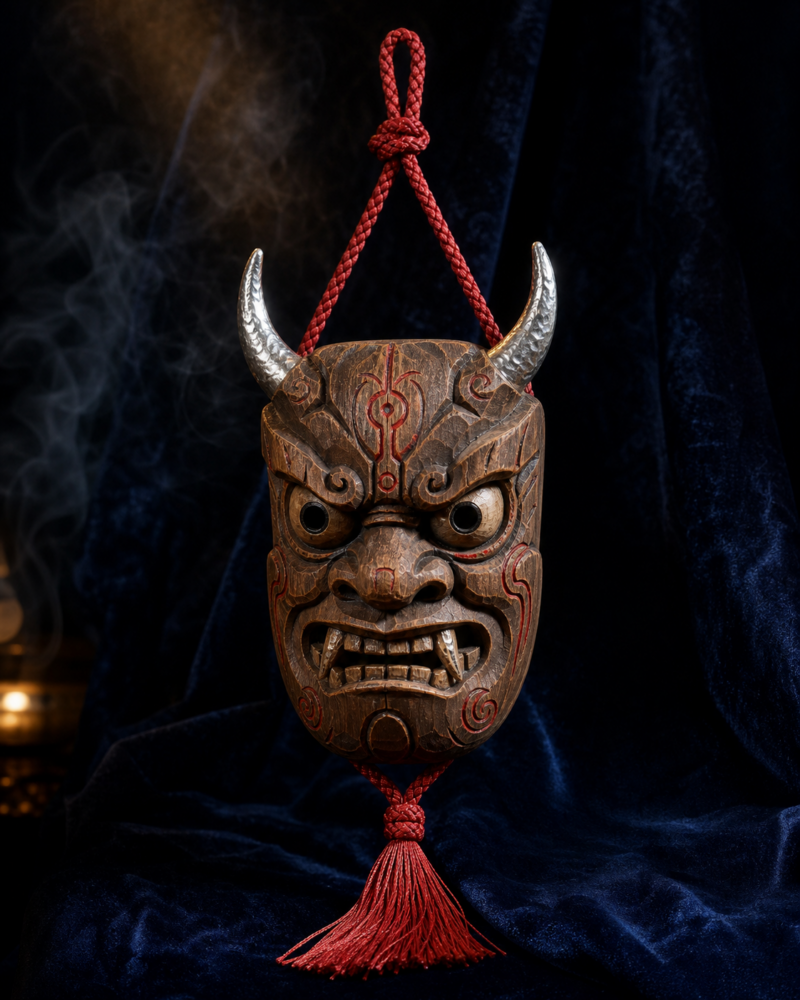
A fierce-deity face carved in wood, carrying a scroll of the last living pictographic script — set to consume what circles you.
Cultural Lineage
Below the Jade Dragon Snow Mountain of Yunnan, the Naxi people keep the last pictographic script still used for its original purpose on this planet. Dongba writing — named for the priests who alone may write it — is not an alphabet describing sounds but a procession of small drawn things: suns, gates, horses, demons, mountains. UNESCO lists its thousand-year manuscript archive among the memories of the world. And unlike the other picture-scripts of antiquity, which survive only in museums, Dongba is still written the old way, for the old reasons: to bless, to cleanse, to guard.
Dongba cosmology is unsentimental about misfortune. The world of the texts is thickly populated — spirits of roads, waters, quarrels and illness — and some of that population feeds on human luck. When a household's fortune soured or its nights filled with circling dreams, the Dongba priest did not counsel patience. He convened a larger appetite. The rites summon fierce guardian deities — huge-eyed, fanged, crowned in flame — whose office is precisely to devour: to eat the accumulated bad luck, the sent malice, the nightmare-traffic that had made a home its feeding ground.
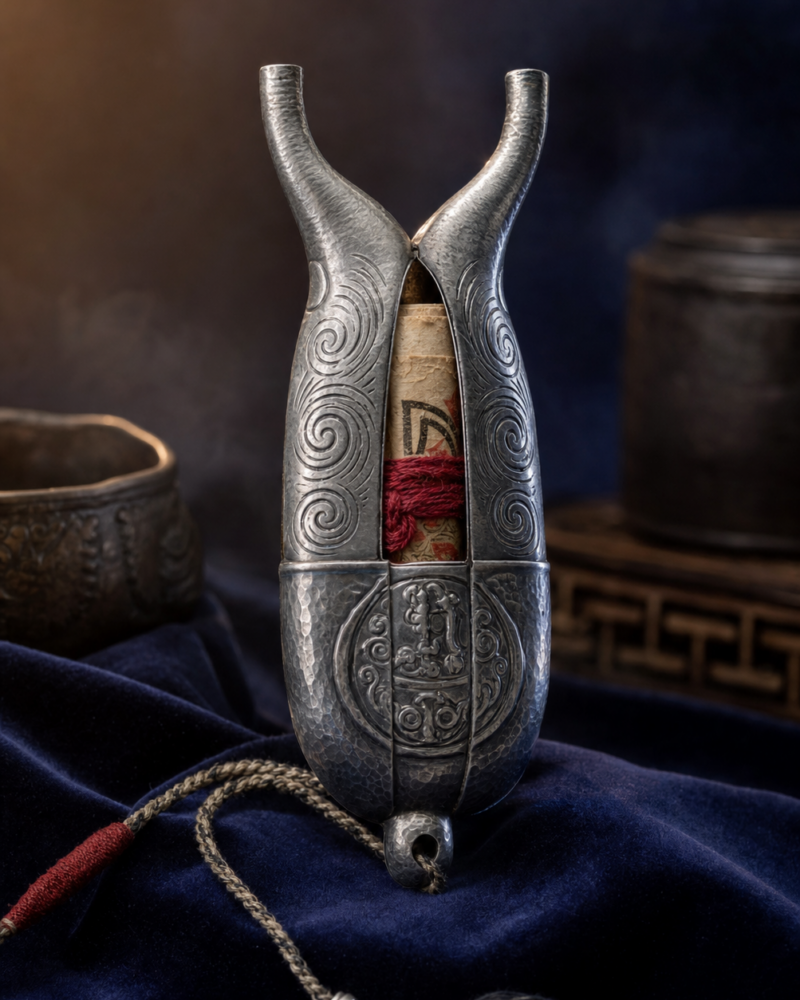
The carved deity face is the fixed seat of that office. Cut from mountain wood, brows knotted, mouth open, it is not a portrait of a demon but of the thing demons answer to. Beneath it, in the tradition of the amulet-scrolls, a strip of handmade paper carries the written rite in Dongba pictographs — the invitation, the naming of what is to be eaten, the dismissal. Face and scroll work as one instrument: the script convenes, the mouth consumes.
Each amulet in this line pairs a face carved in the Naxi workshops with a scroll hand-written in the living script. The tradition survives on a knife's edge — the trained Dongba number in the dozens now, and every commission of new writing is a small act of preservation. What hangs at your wall is therefore two things at once: a working instrument of the old appetite, and a page of the world's last picture-language, still doing its original job.
What Sha It Addresses
The Devourer is composed for the household under double siege — the state in which bad luck and bad nights arrive together and feed each other. If you came here through A Curse of Bad Luck: the run of misfortune with a rhythm too regular for chance, the sense of being specifically found. If you came through The Night Devours Me: the recurring nightmare that knows its way back, the three a.m. waking, the bedroom that no longer feels neutral. Dongba practice treats these as one infestation with two symptoms, and answers both with the same appetite. The amulet does not shield; in the tradition's blunt phrase, it eats. What circles the house is invited to circle once too close.
Detailed Usage Method
The Devourer is seated, fed, and dismissed by the small domestic forms of the Dongba rite; tradition asks that the sequence be kept exactly.
-
Timing — The Waning Moon
Hang the amulet during the waning moon, the fortnight of diminishment, when what is to be eaten is already growing thinner. Tradition avoids seating a Devourer on the waxing tide, which is held to feed the wrong side of the bargain.
-
Placement — Facing the Restless Room
Hang it inside the room where the trouble lives — the bedroom of bad nights, the office of failing luck — facing into the room, never out the window. The Devourer is not a border guard; it hunts the ground it is given.
-
Feeding — Smoke on the Seventh Night
Every seventh night, pass the smoke of a single juniper twig beneath the carved face for the space of ten breaths. In Dongba practice juniper smoke is the guardian's portion — the small wage paid so that its appetite stays turned outward.
-
Dismissal — When the House Grows Quiet
When luck has steadied and the nights have emptied, do not simply take the amulet down. Untie it at morning, wrap face and scroll in plain cloth, and let them rest in a drawer through one full moon before rehanging or storing. A Devourer, the priests say, is stood down, never snatched from its post.
Warnings, Taboos & Prohibitions
- Never hang the Devourer facing a bed's headboard directly. Its watch is for the room, not the sleeper; the old instruction seats it on a side wall, where it sees the door and the window both.
- Do not hang two Devourers in one room. Two appetites in one hunting ground are held to turn on each other, and the room pays for the quarrel.
- The scroll must not be unrolled past its first finger-width. The written rite is complete inside the roll; a fully opened scroll is considered a rite read to its end, and spent.
- Do not touch the carved mouth with bare fingers. The mouth is the working part; in the tradition it is fed with smoke, never with the salt and oil of human skin.
- If the amulet falls during a night of bad dreams, tradition reads a heavy catch — something large came close and was taken. Burn a juniper twig beneath it the same morning and rehang it one hand-width higher than before.
- Never gift a used Devourer onward. What it has eaten stays in its account; a new household deserves a new appetite.
Materials & Craftsmanship
Packaging & Unboxing
The Devourer arrives in a black lacquered box lined with rough-weave cotton, the carved face resting apart from its scroll, joined only at your wall — the pairing of mouth and script is the first act of the seating rite. Folded beside them: a bundle of dried juniper twigs measured for the first seven feedings, and a hand-letterpressed lineage sheet on the Dongba script, the guardian tradition, and the full rite of seating, feeding and standing down. The makers suggest opening the box in daylight, in the room the amulet will hunt, so that its first sight of the ground is by sun.