Cross-Cultural Fusion — Four Traditions
“Global Exorcist” Travel Set — World Protection Quartet
Four traditions, four directions, one case — a portable perimeter for the bearer who sleeps in rooms that owe them nothing.
Cultural Lineage
The fear of the unfamiliar room is one of the oldest documented in human practice. Roman travelers carried their household gods in satchels; caravan masters on the silk roads nailed small wards above every borrowed door; sailors of every sea sewed protection into their coats because a ship's bunk belongs to no one. The logic repeats in every migrating culture: protection, like water, is local — and the traveler is the person who has walked out of range of their own wells.
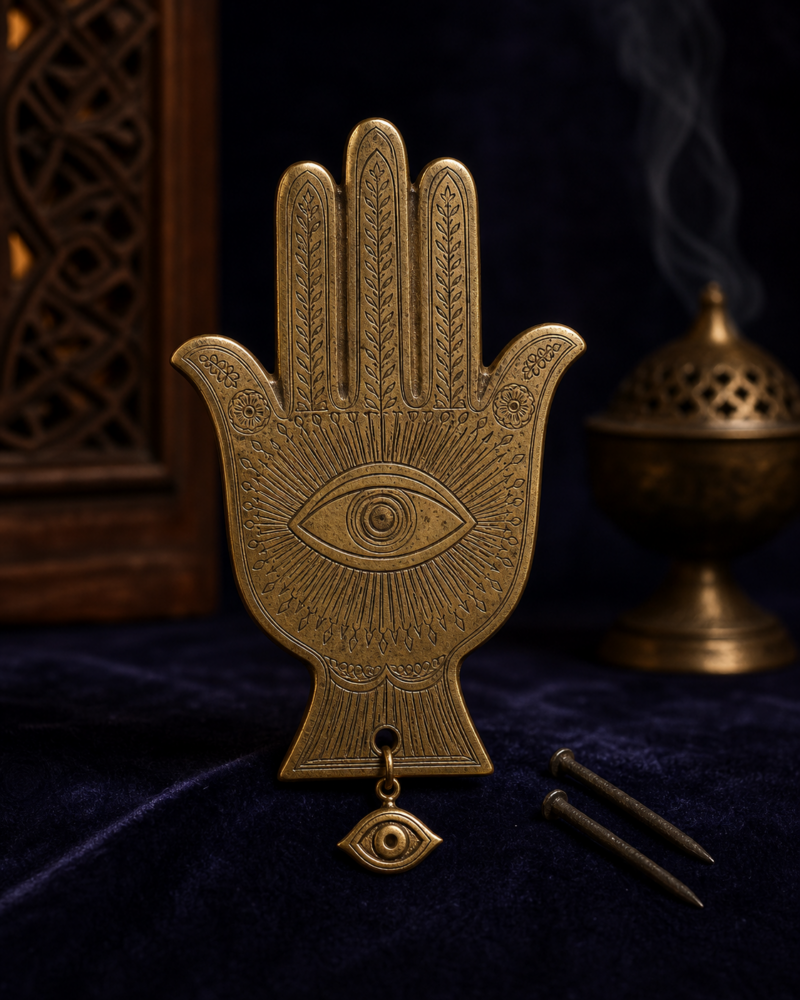
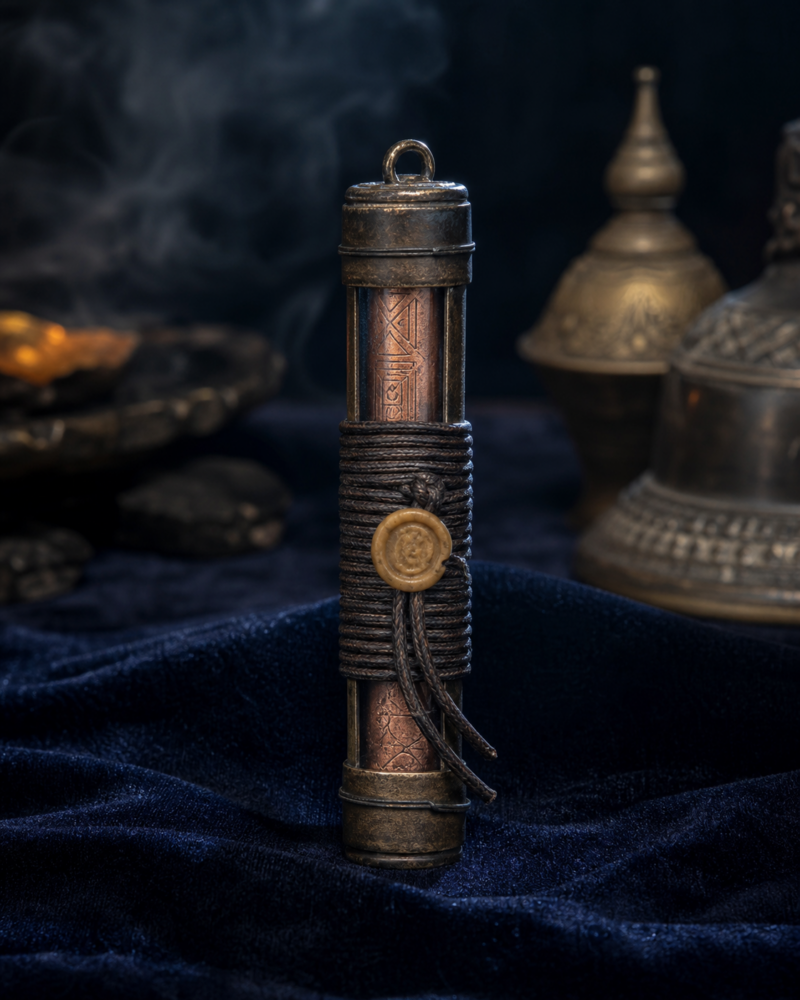
The quartet assembles four of the strongest portable answers the world's traditions produced. From Siam, the takrut: a small metal cylinder holding a rolled, inscribed charm, worn by travelers and traders against the dangers of the road since before Buddhism reached the river valleys. From Egypt, the Wedjat — the restored eye of Horus, the archetypal ward against the hostile gaze, carried by the living and sewn into the wrappings of the dead for their longest journey of all. From Japan, the magatama, the Jomon soul-anchor, steadying the traveler's own spirit when the light falls wrong and nothing tastes of home. And from the Miao mountains of China, the soul-calling bell, whose small bright voice is held to call the scattered parts of a person back to where the body sleeps.
Four objects, four jurisdictions: the road, the gaze, the self, the return. The atelier's fusion is in the arrangement — each piece assigned a cardinal direction so that, laid out in any rented room, the quartet forms the oldest defensive architecture humans know: the guarded square. The traditions never shared a border; the traveler's problem makes them neighbors.
Each piece is made small, in the traveling grades of its own tradition — none longer than a thumb — and the case is unassuming waxed canvas and lacquered card, built to pass through any security tray in the world without conversation.
What Sha It Addresses
The quartet is composed for one suffering only, and completely: the state of being in unfamiliar territory. The relocation that still is not home, the work that lives out of hotels, the migration that left every protective habit a continent behind. Tradition after tradition observes the same thing — that displacement is not mere homesickness but exposure, the condition of standing among a place's spirits unintroduced. The quartet answers as the old travelers answered: by carrying the perimeter with you, so that the introduction is made on your terms, in any room, in the time it takes to set four small objects down.
Detailed Usage Method
The rite is built for a hotel room and takes five minutes; each piece keeps its own direction, and the order of laying never varies.
-
East — The Takrut, First
On arrival, before unpacking anything else, place the takrut at the easternmost point of the room — windowsill, desk, or floor line. The east is the road's direction, and the road is acknowledged first because you have just come off it.
-
West — The Wedjat, Facing the Door
Set the Wedjat at the west, angled so the eye faces the room's entrance. In the Egyptian understanding the restored eye meets every gaze that enters; in a borrowed room, the door is where all gazes arrive.
-
South — The Magatama, Nearest Warmth
Lay the magatama at the south, closest to whatever warmth the room offers. The south is the direction of the sun at its height; the soul-anchor rests there so the self settles toward warmth rather than scattering toward strangeness.
-
North — The Bell, and One Ring
Last, set the soul-calling bell at the north, nearest the head of the bed, and ring it once. One clear note tells the room, in the Miao phrase, who is sleeping here tonight. On departure, gather the quartet in reverse order, bell first, and ring once more at the door.
Warnings, Taboos & Prohibitions
- Never leave the quartet laid out in a room you have checked out of. An abandoned perimeter, the traditions agree, is a door left open in your name.
- Do not lay the square around two beds occupied by strangers to each other. The perimeter holds one household at a time; travelers sharing with colleagues should lay it around their own bed only.
- The bell must not be rung idly, in play, or to demonstrate the set to companions. Its voice is a summons; summons issued for entertainment are held to go unanswered when needed.
- Do not substitute a missing piece with a souvenir or approximation. A three-cornered square is not a smaller ward but a broken one; carry the set complete or carry the takrut alone.
- If a piece is lost on the road, tradition treats it as having stayed behind to close an account you did not see. Do not retrace your steps hunting it. Complete the journey, then write to the atelier for a successor piece and re-seat the square at home before its next travel.
Materials & Craftsmanship
Packaging & Unboxing
The quartet travels in a waxed-canvas roll the size of a spectacles case, lined in black silk, with a sewn pocket for each piece marked only by a small embroidered compass point. Rolled inside is a letterpressed card — the five-minute rite on one face, the law of the unbroken square on the other — and a spare length of waxed cord. The outer case is deliberately plain: to every security scanner and hotel housekeeper on Earth it is a modest accessories roll, and only its bearer knows it is a folded perimeter, waiting for the next room that owes them nothing.